
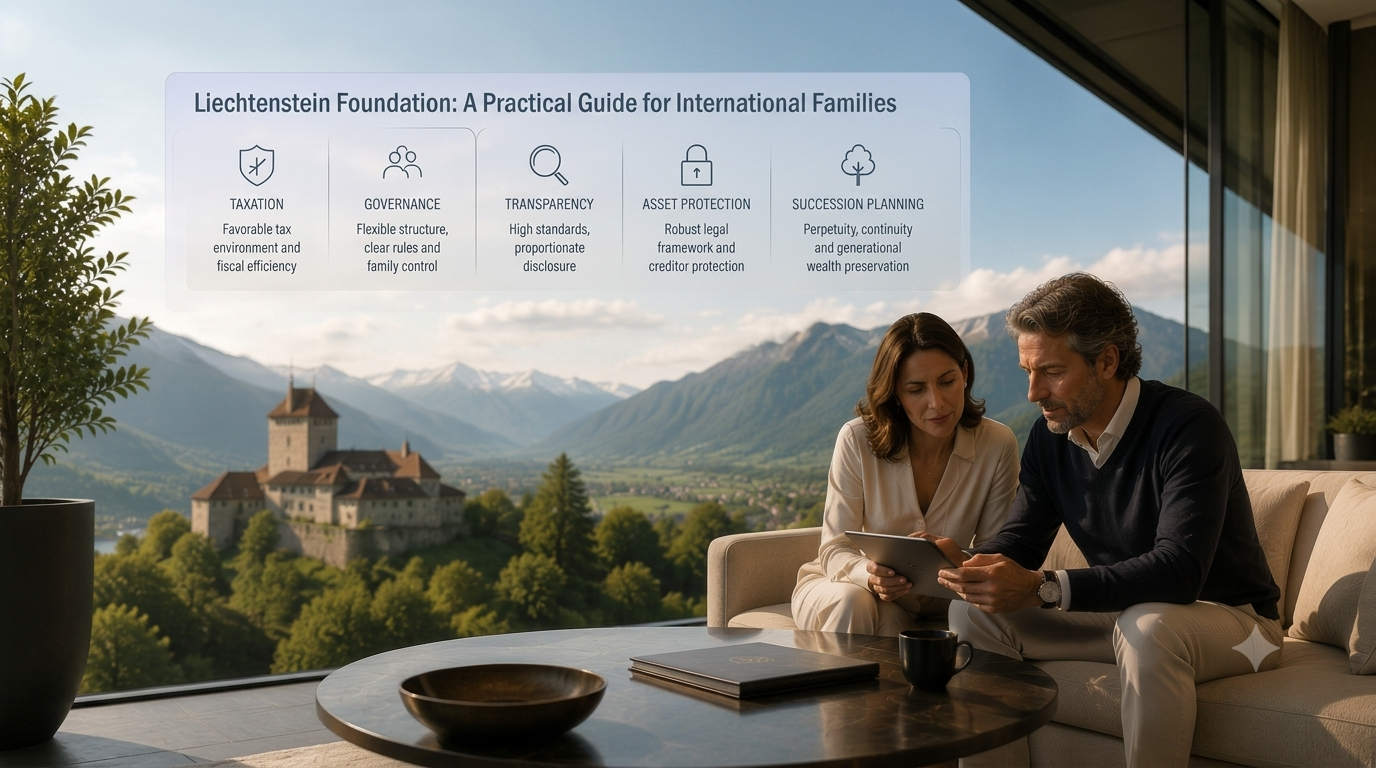

Liechtenstein Foundation: A Practical Guide for International Families
For internationally mobile families, entrepreneurs and family offices, preserving wealth across generations requires more than sound investment management. It demands a legal structure capable of protecting assets, supporting succession planning, maintaining family governance and providing long-term stability across multiple jurisdictions.
Among European wealth-planning vehicles, the Liechtenstein foundation has established itself as one of the most respected and sophisticated solutions for these objectives.
Unlike a company established to conduct commercial activities or a trust that relies on the separation of legal and beneficial ownership, a Liechtenstein foundation creates an independent legal entity that owns and administers assets according to the founder’s wishes. Once established, the foundation becomes the legal owner of the contributed assets, ensuring continuity beyond the founder’s lifetime while allowing carefully drafted governance mechanisms to guide future generations.
For decades, Liechtenstein has been recognised as one of Europe’s leading international wealth-planning centres. Its legal system combines civil-law certainty with decades of experience in private wealth structures. Membership of the European Economic Area (EEA), political stability, a sophisticated financial sector and an extensive network of tax information exchange agreements have further strengthened its position among international families seeking long-term wealth preservation.
This guide examines the legal characteristics, taxation, governance framework, transparency requirements and practical applications of a Liechtenstein foundation. The analysis is intended for ultra-high-net-worth (UHNW) families, family offices, entrepreneurs, trustees and professional advisers evaluating whether a Liechtenstein foundation should form part of an international wealth-planning strategy.
Legal Nature of a Liechtenstein Foundation
A Liechtenstein foundation (Stiftung) is an independent legal person established under the Persons and Companies Act (Personen- und Gesellschaftsrecht – PGR). Unlike a corporation, it has no shareholders or members. Instead, it exists solely to pursue the purpose defined by its founder in the foundation deed and accompanying regulations.
The legal separation created by the foundation is fundamental. Once assets are validly transferred into the foundation, ownership passes from the founder to the foundation itself. The founder no longer owns those assets personally. Instead, they are administered by the Foundation Council exclusively in accordance with the foundation documents.
This characteristic distinguishes foundations from many other wealth-planning vehicles. Companies remain controlled through shareholders, while trusts divide ownership between trustees and beneficiaries under common law. A foundation follows neither model. It is neither shareholder-owned nor beneficiary-owned. Rather, it becomes an autonomous legal entity governed by its constitutional documents.
Liechtenstein law provides significant flexibility when drafting those constitutional documents. The founder may specify the foundation’s objectives, define classes of beneficiaries, establish succession mechanisms, appoint protectors or supervisory bodies, determine investment principles and regulate how future amendments may be made. This flexibility explains why foundations are frequently used for long-term family governance rather than simple tax planning.
Another notable feature is continuity. Because the foundation exists independently of any individual, it is unaffected by the death, incapacity or relocation of the founder or beneficiaries. This makes it particularly suitable for families whose members reside in different countries or whose business interests span multiple jurisdictions.
Unlike many offshore structures of previous decades, today’s Liechtenstein foundation operates within a comprehensive regulatory framework that includes anti-money laundering legislation, beneficial ownership reporting, international tax transparency standards and CRS reporting obligations where applicable. As a result, modern foundations are designed to support compliant international wealth planning rather than secrecy.
Private, Family and Charitable Foundations
Liechtenstein law recognises several categories of foundations, each designed for different purposes. Selecting the appropriate structure depends primarily on the family’s long-term objectives rather than on tax considerations alone.
The most common vehicle for private wealth planning is the private family foundation. Its principal objective is the preservation, management and orderly transfer of family wealth across generations. Such foundations commonly hold diversified investment portfolios, shares in operating companies, real estate, intellectual property or other strategic assets.
Many entrepreneurial families establish a foundation before transferring ownership of a family business. Rather than dividing shares among multiple heirs, the business remains owned by the foundation while family members become beneficiaries according to predetermined rules. This approach can reduce ownership fragmentation, preserve voting stability and facilitate long-term succession planning.
Charitable foundations pursue exclusively or primarily public-benefit purposes such as education, healthcare, scientific research or cultural activities. These foundations operate under different regulatory requirements and may qualify for specific tax treatment depending on their activities.
Mixed-purpose foundations are also possible, allowing a family to combine private wealth preservation with philanthropic initiatives. For example, the foundation may provide financial support to family members while simultaneously funding scholarships, museums or charitable programmes through dedicated allocation policies.
Another important distinction concerns registered and non-registered foundations. Foundations conducting commercial activities or subject to statutory registration requirements appear in the Commercial Register. Many private family foundations, however, remain outside public registration requirements while still being subject to regulatory supervision, AML obligations and beneficial ownership reporting where applicable.
The flexibility of Liechtenstein legislation allows the foundation regulations to remain confidential while preserving legal certainty. These internal regulations frequently contain detailed governance rules, beneficiary provisions and succession mechanisms that are not included in the publicly available foundation deed.
For international families, this combination of legal certainty, flexibility and continuity explains why the Liechtenstein foundation remains one of Europe’s preferred succession-planning vehicles.
Taxation of a Liechtenstein Foundation
Taxation is one of the most frequently discussed aspects of a Liechtenstein foundation, yet it is also one of the most frequently misunderstood. Contrary to outdated assumptions, a modern Liechtenstein foundation is neither a tax-exempt nor a secrecy vehicle. Instead, it operates within a transparent legal and tax framework that complies with OECD standards, the Common Reporting Standard (CRS), anti-money laundering legislation and international exchange-of-information agreements. For international families, the principal advantage of a Liechtenstein foundation lies not in aggressive tax optimisation but in legal certainty, asset protection and succession planning.
As a legal entity incorporated in Liechtenstein, a foundation is generally subject to corporate income tax under the rules published by the Liechtenstein National Administration. Since the comprehensive tax reform that entered into force in 2011, Liechtenstein has applied a single corporate income tax rate of 12.5%, one of the lowest standard corporate tax rates in Europe. Unlike many jurisdictions that apply multiple federal, regional and municipal taxes, Liechtenstein levies only a single national corporate income tax, making the regime comparatively straightforward and predictable.
The taxable base depends on the nature of the foundation’s activities and income. In practice, many private family foundations generate investment income through diversified portfolios, private equity investments, shareholdings in operating companies, bonds, real estate or other financial assets. Depending on the specific circumstances and applicable exemptions under Liechtenstein tax law, the effective tax burden may differ significantly from the statutory rate. Cross-border taxation also depends on the jurisdictions in which the underlying assets are located and where beneficiaries are tax resident.
One important distinction concerns the Private Asset Structure (PAS). A foundation qualifying as a PAS is restricted to the passive management of private wealth and may not conduct commercial activities. It may invest in securities, bank deposits, investment funds, privately held companies or real estate intended for long-term wealth preservation, but it cannot actively operate a trading business. The PAS regime reflects Liechtenstein’s long-standing objective of distinguishing genuine private wealth management from commercial enterprise.
Liechtenstein does not levy inheritance tax, estate tax or gift tax at the national level. Likewise, distributions made by the foundation are generally not subject to Liechtenstein withholding tax. Nevertheless, beneficiaries may become taxable in their country of residence depending on domestic tax legislation. Consequently, international tax advice remains essential before establishing any cross-border wealth structure.
International families should also recognise that a foundation does not eliminate taxation in other jurisdictions. Dividends received from foreign companies may be subject to withholding tax in the source country. Rental income from foreign real estate is generally taxed where the property is located. Capital gains may also be taxed under the legislation of the jurisdiction where the underlying assets are situated. The foundation therefore functions as a coordinating legal structure rather than a mechanism for avoiding taxation.
Because tax authorities increasingly analyse the substance and economic purpose of cross-border structures, the long-term effectiveness of a Liechtenstein foundation depends upon genuine governance, proper documentation and professional administration. Foundations established solely to obtain tax advantages, without a legitimate succession or asset-protection purpose, are considerably more likely to face scrutiny under modern anti-abuse principles.
Governance, Founder Rights and Beneficiaries
The governance framework of a Liechtenstein foundation is one of its greatest strengths. Rather than relying on informal family arrangements, the foundation provides legally enforceable rules governing decision-making, succession and the management of family wealth over multiple generations.
The founder establishes the foundation by contributing assets and defining its constitutional documents. These documents normally include the Foundation Deed (Stiftungsurkunde) and detailed Foundation Regulations (Stiftungsreglement). While the Foundation Deed establishes the legal existence of the entity, the Regulations usually contain the operational rules governing beneficiaries, investment policies, succession procedures and the powers of the governing bodies.
The Foundation Council serves as the executive management body of the foundation. Comparable to a board of directors, the Council is responsible for administering foundation assets, implementing the founder’s wishes and ensuring compliance with applicable law. At least one member of the Council must normally satisfy Liechtenstein’s professional qualification and residency requirements, ensuring that the foundation maintains genuine local governance rather than existing merely as a paper structure.
The founder may reserve certain powers when establishing the foundation, although these powers cannot undermine the legal independence of the foundation itself. Depending on the drafting of the constitutional documents, reserved rights may include the appointment or removal of Council members, amendment of foundation regulations, appointment of protectors or supervisory bodies and, in certain circumstances, modification of beneficiary provisions. The precise extent of founder rights depends upon the foundation’s drafting and applicable provisions of Liechtenstein law.
Beneficiaries may be specifically named individuals or classes of persons defined by objective criteria. Many family foundations identify beneficiaries by family branch rather than by individual name, allowing future generations to benefit without repeated amendments to the constitutional documents. Distributions may be mandatory, discretionary or conditional upon events such as reaching a specified age, completing education or participating in the family business.
Many sophisticated structures also appoint a Protector or Advisory Committee. Although not mandatory under Liechtenstein law, these bodies provide additional oversight by supervising the Foundation Council, approving significant investment decisions or resolving disputes between family members. For entrepreneurial families with substantial operating businesses, this additional governance layer often contributes significantly to long-term stability.
The flexibility of the governance framework explains why many advisers regard the Liechtenstein foundation not merely as an ownership vehicle but as an instrument of family governance. Properly drafted constitutional documents establish clear procedures for decision-making, succession, dispute resolution and long-term stewardship, reducing uncertainty during future generational transitions.
Transparency, CRS and Asset Protection
The international regulatory landscape has changed fundamentally over the past decade. The modern Liechtenstein foundation no longer operates in an environment characterised by banking secrecy or limited regulatory oversight. Instead, it functions within one of Europe’s most mature compliance frameworks, combining robust asset protection with extensive transparency obligations. For international families, this shift has reinforced the legitimacy of Liechtenstein foundations as long-term governance vehicles rather than secrecy structures.
Liechtenstein is a member of the European Economic Area (EEA) and has fully implemented international standards developed by the Organisation for Economic Co-operation and Development (OECD).
The jurisdiction participates in the Common Reporting Standard (CRS), has concluded numerous Tax Information Exchange Agreements (TIEAs), and applies comprehensive anti-money laundering (AML) and counter-terrorist financing (CTF) legislation. Financial institutions administering foundation assets are therefore required to conduct extensive due diligence and report information where required by applicable law.
Every foundation must identify its beneficial owners, controlling persons and other relevant stakeholders under Liechtenstein’s beneficial ownership legislation. Professional trustees, banks and fiduciary service providers are subject to strict Know Your Client (KYC) procedures before accepting a foundation as a client. Source of wealth, source of funds and the economic rationale for the structure must be documented and maintained throughout the relationship.
These transparency obligations should not be viewed as disadvantages. On the contrary, they provide legal certainty for internationally mobile families operating in an increasingly regulated environment. Structures established with legitimate succession planning, asset protection and governance objectives are significantly more resilient than opaque arrangements designed primarily for confidentiality or tax avoidance.
Asset protection remains one of the principal reasons families establish a Liechtenstein foundation. Once assets have been validly transferred to the foundation, they cease to form part of the founder’s personal estate. Subject to applicable fraudulent transfer rules and creditor protection legislation, future personal liabilities of the founder generally do not automatically extend to assets legally owned by the foundation.
This separation can be particularly valuable for entrepreneurs whose businesses involve commercial risks. By transferring strategic family assets into an independent legal entity before any foreseeable creditor claims arise, families may reduce the likelihood that future business disputes jeopardise long-term family wealth. However, no asset protection strategy is absolute. Courts in many jurisdictions retain powers to challenge transactions undertaken with the intent to prejudice existing creditors or circumvent insolvency legislation.
Equally important is protection against family disputes. Properly drafted foundation regulations establish objective rules governing distributions, succession and governance, thereby reducing uncertainty during generational transitions. Instead of relying upon wills that may be contested or fragmented ownership among multiple heirs, the foundation continues to administer assets according to predetermined principles established by the founder.
For internationally connected families, the greatest value of the modern Liechtenstein foundation lies in balancing transparency with legal certainty. Rather than concealing ownership, it provides a recognised legal framework through which wealth may be preserved, administered and transferred across generations while remaining fully compliant with international reporting standards.
When Does a Liechtenstein Foundation Make Sense?
Although the Liechtenstein foundation is one of Europe’s most sophisticated wealth-planning vehicles, it is not universally appropriate. The decision to establish a foundation should always be driven by family objectives, governance requirements and succession considerations rather than by tax planning alone.
One of the most common use cases involves business succession. Many entrepreneurial families face the challenge of transferring ownership of an operating company to the next generation without fragmenting voting rights or disrupting strategic control. By placing company shares into a foundation, ownership remains stable while family members become beneficiaries under clearly defined governance rules. The Foundation Council exercises ownership rights according to the founder’s long-term vision rather than short-term family dynamics.
International families frequently use foundations to consolidate diversified assets located across multiple jurisdictions. Investment portfolios, family offices, private equity interests, intellectual property and strategic real estate holdings may all be administered within a single governance framework. This centralisation often simplifies long-term administration while improving consistency of investment oversight.
Another important application concerns vulnerable beneficiaries. Parents or grandparents may wish to provide financial support without transferring unrestricted ownership at an early age. Foundation regulations can permit distributions for education, healthcare, housing or entrepreneurship while preventing irresponsible spending or external influence. Such provisions frequently extend over several generations, preserving wealth while encouraging responsible stewardship.
Philanthropic planning also represents a significant use case. Many families combine charitable giving with private wealth preservation by establishing foundations that allocate part of annual income to educational, scientific, cultural or humanitarian initiatives. Unlike ad hoc donations, the foundation creates a permanent institutional framework capable of supporting charitable objectives over decades.
Nevertheless, a foundation is not always the optimal solution. Families seeking maximum flexibility, short-term investment structures or simple holding arrangements may find alternative vehicles more appropriate. In common-law jurisdictions, trusts may offer greater familiarity. For purely corporate investments, holding companies may provide a more efficient operational structure. The appropriate vehicle depends upon the family’s legal environment, residence, tax profile, governance objectives and succession strategy.
Accordingly, the decision should never be based solely on one jurisdiction’s tax regime or perceived confidentiality. Instead, families should evaluate how the proposed structure integrates with their broader governance framework, international tax position and long-term succession planning. In practice, the most successful structures are those designed holistically rather than selected for a single perceived advantage.
Comparative Table — Liechtenstein Foundation vs Trust vs Holding Company
| Parameter | Liechtenstein Foundation | Trust | Holding Company |
|---|---|---|---|
| Legal personality | Yes | No (legal relationship) | Yes |
| Primary purpose | Succession, governance and wealth preservation | Asset protection and succession planning | Corporate ownership and investments |
| Ownership of assets | Foundation owns assets | Trustee holds legal title | Company owns assets |
| Shareholders | None | None | Yes |
| Suitable for family governance | Excellent | Very good | Limited |
| Business succession | Excellent | Good | Good |
| Philanthropic activities | Excellent | Possible | Limited |
| Continuity after founder’s death | Yes | Yes | Depends on shareholders |
| International recognition | High | Very high in common-law jurisdictions | Very high |
Frequently Asked Questions (FAQ)
What is a Liechtenstein foundation?
A Liechtenstein foundation is an independent legal entity established under the Liechtenstein Persons and Companies Act (PGR) for a specific purpose defined by its founder. Unlike a company, it has no shareholders, and unlike a trust, it does not rely on the separation of legal and beneficial ownership. Once assets are transferred to the foundation, it becomes their legal owner and administers them according to the Foundation Deed and Foundation Regulations. This legal independence makes the foundation particularly suitable for succession planning, family governance and long-term wealth preservation.
What assets can be transferred into a Liechtenstein foundation?
Almost any legally transferable asset may be contributed to a foundation. Typical examples include shares of private companies, listed securities, investment portfolios, real estate (subject to local property laws), intellectual property, family businesses, works of art, yachts and other high-value assets. International families often consolidate diversified holdings within one foundation to simplify governance and succession planning. Before transferring assets, however, legal, tax and regulatory implications should be analysed in every relevant jurisdiction.
Does a Liechtenstein foundation provide complete asset protection?
No legitimate legal structure can guarantee absolute protection from creditors or legal claims. A Liechtenstein foundation may provide significant protection because contributed assets become legally owned by the foundation rather than by the founder personally. Nevertheless, courts may challenge transfers intended to defraud existing creditors or circumvent insolvency rules. Effective asset protection therefore depends on proper planning undertaken well before any foreseeable disputes arise and must always comply with applicable law.
Is a Liechtenstein foundation more suitable than a trust?
Neither structure is universally superior. A foundation is often preferred by families from civil-law jurisdictions because it is an independent legal person rather than a contractual relationship. Trusts remain highly effective in common-law jurisdictions with established trust jurisprudence. The appropriate choice depends on the family’s residence, the location of assets, succession objectives, governance preferences and the legal systems involved. Many international families evaluate both structures before selecting the most appropriate solution.
Are Liechtenstein foundations confidential?
Modern Liechtenstein foundations provide an appropriate degree of privacy but do not operate anonymously. Foundation documents may not be publicly available in the same manner as company shareholder registers; however, financial institutions, fiduciaries and competent authorities have access to relevant ownership and control information under AML, CRS and beneficial ownership legislation. The emphasis today is on legitimate confidentiality combined with full regulatory compliance rather than secrecy.
Who controls the foundation after the founder’s death?
Following the founder’s death, the foundation continues to operate according to its constitutional documents. The Foundation Council remains responsible for administration, while Protectors or Supervisory Boards (where appointed) exercise oversight. Beneficiaries receive distributions in accordance with the Foundation Regulations rather than through probate proceedings. This continuity is one of the principal reasons entrepreneurial families use foundations for long-term succession planning.
When is a Liechtenstein foundation most appropriate?
A Liechtenstein foundation is generally most suitable for families with substantial international assets, operating businesses, multiple generations of beneficiaries or long-term philanthropic objectives. It is particularly effective where preserving family control, avoiding fragmented ownership, implementing governance rules and facilitating orderly succession are higher priorities than short-term tax considerations. Families with simpler ownership structures or purely commercial investment objectives may instead prefer holding companies or other corporate vehicles.
Conclusion — Is a Liechtenstein Foundation the Right Solution?
The Liechtenstein foundation remains one of Europe’s most sophisticated legal structures for long-term wealth preservation, family governance and succession planning. Rather than functioning as a tax-driven vehicle, it provides an institutional framework through which international families can centralise ownership, establish clear governance rules and ensure continuity across multiple generations. Its legal independence, flexible constitutional framework and mature regulatory environment distinguish it from both trusts and conventional holding companies.
Modern international wealth planning increasingly focuses on governance rather than tax optimisation. Regulatory initiatives such as the OECD Common Reporting Standard, enhanced beneficial ownership requirements and strengthened anti-money laundering rules have fundamentally changed the environment in which cross-border structures operate. Within this landscape, the strength of the Liechtenstein foundation lies in its transparency, legal certainty and ability to support legitimate long-term family objectives while remaining fully compliant with international standards.
For internationally active families, succession planning should not be viewed as a single legal transaction but as an ongoing governance process. A well-designed foundation can reduce ownership fragmentation, establish objective distribution policies, protect strategic assets from future uncertainty and provide an effective framework for preserving both financial and non-financial family capital. Equally important, it creates continuity that extends beyond the lifetime of any individual family member.
Nevertheless, no structure should be selected solely because it is well known or widely used. The effectiveness of any foundation depends on its integration with the family’s broader legal, tax and governance architecture. Residence of family members, location of assets, applicable succession rules, corporate ownership structures and cross-border tax implications must all be considered together. For many international families, a Liechtenstein foundation forms one element of a comprehensive wealth-planning strategy that may also include holding companies, trusts, family constitutions and other governance mechanisms.
Ultimately, the value of a foundation is measured not by tax savings but by its ability to preserve stability across generations. When properly designed, professionally administered and aligned with the family’s long-term objectives, a Liechtenstein foundation provides a durable legal framework capable of protecting wealth, supporting responsible stewardship and facilitating orderly succession for decades to come.

