
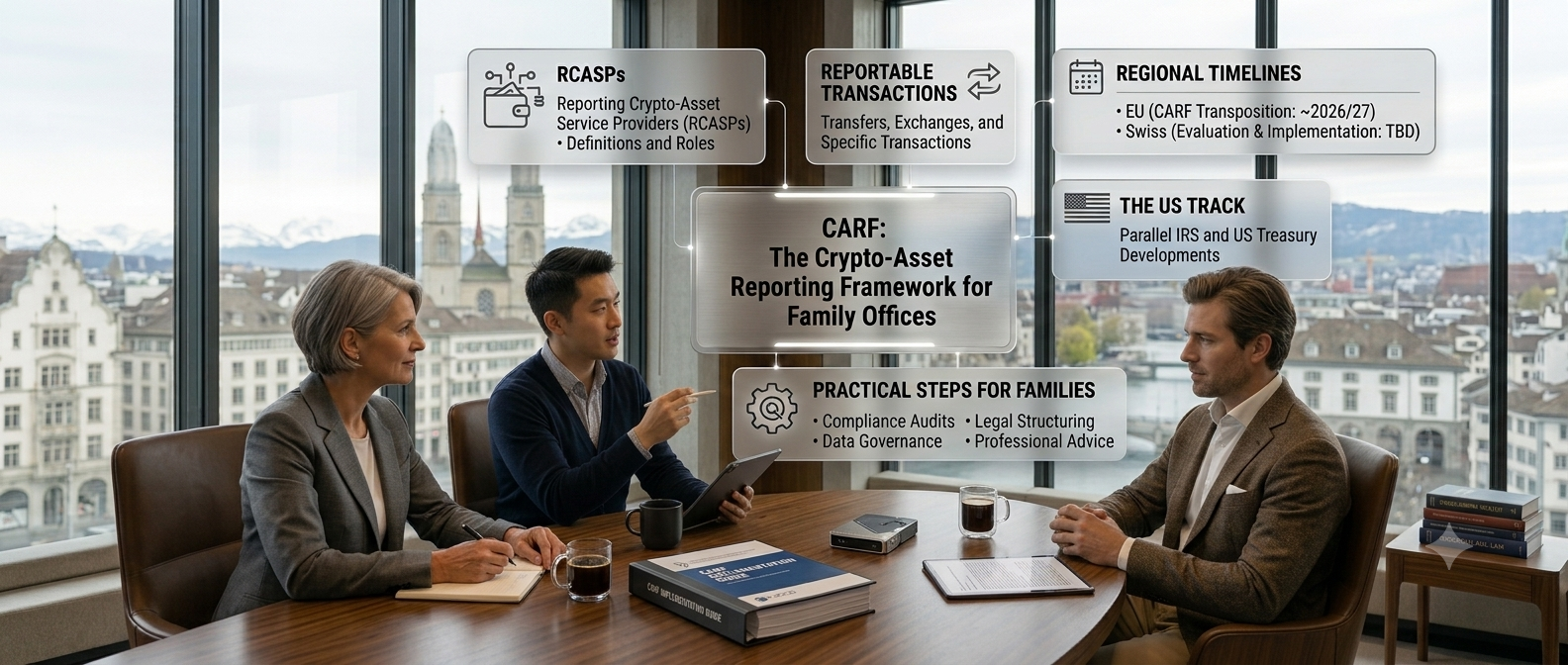

CARF: The Crypto-Asset Reporting Framework for Family Offices
For family offices holding crypto-assets, the era of tax invisibility is ending. The OECD’s Crypto-Asset Reporting Framework (CARF) extends the automatic exchange of tax information — long established for traditional financial accounts under the Common Reporting Standard — to the world of crypto. From 2026 onwards, crypto-asset transactions that were previously outside the reach of tax authorities will be systematically collected by service providers and exchanged automatically between jurisdictions. For family offices with crypto exposure, understanding CARF is no longer optional; it is a compliance necessity.
This article provides a structured analysis of CARF for family offices with crypto-asset holdings. It examines what CARF is and how it works, who qualifies as a reporting provider, what transactions are reportable, the phased global implementation timeline, the specific Swiss position, and the practical steps family offices should take now. All dates, thresholds and legal references have been verified against official OECD, EU and Swiss sources as of 2026. For any family office active in digital assets, mastering the essentials of crypto reporting under CARF is a defining task of the current compliance cycle.
What CARF Is and How It Works
The Crypto-Asset Reporting Framework is an international standard developed by the OECD and approved in October 2022. Its purpose is to extend the automatic exchange of information (AEOI) between tax authorities to transactions in crypto-assets, closing the gap that previously existed between traditional financial assets — already reported under the Common Reporting Standard (CRS) since 2017 — and the rapidly growing crypto sector. In essence, CARF does for crypto what the CRS has done for bank accounts: it requires service providers to collect information on their users and their transactions, report it to their domestic tax authority, and enables that authority to exchange the information automatically with the jurisdiction where each user is tax resident.
CARF follows the architecture and operational logic of the CRS but is adapted to the specific characteristics of crypto-assets. The two frameworks are deliberately complementary rather than overlapping: CARF captures transactions in crypto-assets, while the CRS — as expanded under CRS 2.0 — captures holdings of financial accounts, including certain indirect crypto exposure, electronic money products and central bank digital currencies. Importantly, CBDCs and specified electronic money products are excluded from CARF and instead fall within the expanded CRS. The OECD has stitched the two frameworks together so that, in principle, nothing falls between them and double reporting is minimised.
The mechanics of CARF require reporting providers to perform three core functions. First, they must collect identifying information and tax-residence self-certifications from their customers, applying due-diligence procedures that are — to the extent possible — consistent with those of the CRS, reducing the burden on providers already subject to the CRS. Second, they must monitor and record reportable transactions throughout the year. Third, they must report the aggregated data annually to their domestic tax authority, which then exchanges it with the relevant partner jurisdictions under the CARF Multilateral Competent Authority Agreement (CARF-MCAA). The framework and its supporting XML schemas are published by the OECD Crypto-Asset Reporting Framework.
For family offices, the significance is direct. Crypto-assets held through exchanges, custodians or other reporting providers will be reported to the tax authority of the family member’s country of residence, in the same way that a bank account has been reportable under the CRS for years. The pseudonymity that once characterised crypto holdings within the custodial ecosystem effectively ceases to provide privacy once CARF is fully operational.
Who Is a Reporting Crypto-Asset Service Provider (RCASP)?
The reporting obligation under CARF falls on Reporting Crypto-Asset Service Providers (RCASPs). The OECD defines an RCASP broadly as “any individual or entity that, as a business, provides a service effectuating Exchange Transactions for or on behalf of customers.” This deliberately wide definition is designed to keep pace with the rapidly developing crypto market, and it captures a range of providers including centralised and certain decentralised crypto-asset exchanges, brokers, dealers, market makers, crypto ATM operators and providers who make available a trading platform.
The reporting obligation arises where the provider executes exchange transactions, either directly or through sufficient influence — for example, via a trading platform or a smart contract. Conversely, providers with purely technical functions unrelated to the execution of exchange transactions do not qualify as RCASPs. This carve-out includes the mere transfer, custody or management of crypto-assets, and the provision of software or infrastructure that does not enable the independent execution of, or influence over, exchange transactions. The distinction turns on whether the provider effectuates exchange transactions, not merely whether it touches crypto-assets.
For family offices, the RCASP question has two dimensions. The first, and more common, is that the family office is a customer of an RCASP — the exchanges, custodians and brokers through which the family holds crypto are RCASPs, and they will report the family’s data. The second, less common but material, is that a family office structure that itself provides crypto-asset exchange services — for example, an in-house trading desk that effectuates exchange transactions for connected entities — could potentially fall within the RCASP definition, depending on the precise structure and activity. This requires careful analysis, since the RCASP definition extends to individuals and entities acting as a counterparty or intermediary to exchange transactions.
A further point of practical importance is that most RCASPs are already regulated for anti-money-laundering purposes. The OECD notes that RCASPs are expected to fall within the scope of obliged entities for Financial Action Task Force purposes (virtual asset service providers), meaning they should already be collecting KYC and AML documentation from their customers. In Switzerland, such providers are already subject to FINMA supervision for AML purposes and require, depending on their activity, a FinTech licence or affiliation with a self-regulatory organisation. CARF adds a systematic tax-reporting duty on top of these existing obligations.
What Transactions Are Reportable Under CARF
CARF applies to “relevant crypto-assets”, broadly defined as digital representations of value that rely on cryptographically secured distributed ledger technology (DLT) or similar technology to validate and secure transactions. A crypto-asset is “relevant” if it can be used for payment or investment purposes — the decisive factor being the actual economic purpose of use, not the regulatory classification under financial-market law. This captures cryptocurrencies, stablecoins, and certain other tokens, while excluding CBDCs and specified electronic money products (which fall under the expanded CRS) and crypto-assets that cannot be used for payment or investment.
Three categories of transaction are reportable under CARF. The first is exchanges between relevant crypto-assets and fiat currencies — the classic buy and sell transactions. The second is exchanges between one or more forms of relevant crypto-assets — crypto-to-crypto swaps, which are frequently overlooked by holders but are fully within scope. The third is transfers of relevant crypto-assets, including Reportable Retail Payment Transactions, where an intermediary processes payments on behalf of a merchant accepting crypto-assets for goods or services exceeding a defined threshold.
For each reportable user, the RCASP reports a defined data package that follows the established CRS design: the user’s identifying information, tax residence and taxpayer identification number, together with the aggregated transaction data — acquisitions, disposals, crypto-to-crypto exchanges and transfers, reported by type and value. Users and their controlling persons are reportable if at least one of their jurisdictions of tax residence is a reportable jurisdiction for CARF purposes. For family offices, this means that the full pattern of a family’s crypto activity through a given provider — not merely the year-end holding — becomes visible to the tax authority of the family member’s country of residence.
A notable feature of the final CARF rules is what they do not capture. The original OECD proposal of March 2022 included a requirement to report wallet addresses and the value of transfers to unhosted (self-custody) wallets; this element was removed from the final rules following industry comments. Private wallets — hardware wallets and self-custody software — are not themselves directly reportable. However, this offers less privacy than it might appear: when crypto moves between an exchange and a private wallet, the exchange reports both the inflow and the outflow. The transfer to self-custody is therefore visible even though the wallet itself is not directly reported.
The Global Implementation Timeline — Two Waves and a Separate US Track
CARF implementation is proceeding in waves, and understanding the timing is essential because it differs materially by jurisdiction. As of the most recent OECD data, more than 70 jurisdictions have committed to CARF, with over 50 having signed the CARF Multilateral Competent Authority Agreement.
The first wave comprises approximately 48 jurisdictions — including all EU member states, the United Kingdom and the Cayman Islands — where data recording began on 1 January 2026, with the first cross-border exchange in 2027. In the EU, CARF is implemented through the Eighth Directive on Administrative Cooperation (DAC8), which member states were required to transpose into national law by 31 December 2025; crypto-asset service providers must comply with the reporting obligations from 1 January 2026, with the first reporting covering the 2026 calendar year due in the relevant member state by 31 January 2027. Notably, DAC8 is extraterritorial in scope, requiring crypto providers to report on EU residents even where the provider is not itself operating in the EU.
The second wave comprises jurisdictions — including Switzerland, the UAE and Hong Kong — where data recording begins on 1 January 2027, with the first cross-border exchange in 2028. These jurisdictions have one additional year of runway, but the delay is a closing door rather than an open one: the intervening period should be used to build clean data and compliance systems, not to defer engagement.
The United States operates on a separate track entirely. Rather than adopting CARF directly in the first instance, the US applies its own regime through Form 1099-DA under Internal Revenue Code §6045, with gross-proceeds reporting on 2025 sales and cost-basis reporting for 2026 transactions. The US is expected to join CARF around 2028. Significantly, the US regime — like DAC8 — applies extraterritorially to exchanges dealing with US persons, and FATCA continues to apply on top. In the absence of full US-OECD alignment, the result resembles the CRS/FATCA split that already applies to traditional financial account reporting.
The Swiss Position — Legal Basis in Force, Exchange Deferred to 2027
For family offices with a Swiss nexus, the Swiss position on CARF is nuanced and requires precise understanding. Switzerland has committed to implementing CARF, and the legal basis — the amendment to the Federal Act on the International Automatic Exchange of Information in Tax Matters (AEOIA) and the AEOI Ordinance — was approved by the Swiss Parliament in the final vote on 26 September 2025 and entered into force on 1 January 2026. On its face, this would place Switzerland alongside the first wave.
However, the actual application of CARF in Switzerland has been deferred. On 26 November 2025, the Federal Council decided that the crypto provisions would not apply in 2026. According to the Swiss State Secretariat for International Financial Matters, the CARF-MCAA cannot yet be activated, and until it is, the international treaty does not apply in Switzerland — meaning no CARF duties apply in Switzerland in 2026. The practical effect is that reporting crypto-asset service providers will not be required to exercise CARF due diligence under Swiss law in 2026; data recording is expected to begin on 1 January 2027, with the first automatic exchange in 2028. The postponement is tied to ongoing alignment with partner jurisdictions on data security and confidentiality.
The scope of Switzerland’s planned exchange is broad. The Federal Council’s dispatch of 6 June 2025 provides for the exchange of CARF data with a total of 74 partner jurisdictions considered particularly relevant for crypto-asset transactions — including all EU member states, the United Kingdom and the majority of G20 countries, with the notable exceptions of the United States, China and Saudi Arabia. Effective data exchange will, however, only take place with jurisdictions that have themselves implemented CARF and meet the requirements for bilateral cooperation. Swiss RCASPs will report to the Federal Tax Administration (FTA) annually, and the FTA will exchange the information with relevant partner jurisdictions.
For Swiss-based family offices and the RCASPs they use, the deferral creates what practitioners describe as a “compliance without visible upside” phase: the due-diligence and data-collection systems must still be built, even though cross-border exchange will not begin until 2027 or later. The prudent approach is to use the additional Swiss runway to establish clean data infrastructure and processes, rather than to treat the delay as a reprieve. The interaction of CARF with Switzerland’s existing AEOI (CRS) framework, and the sequencing of the two, is a distinctive feature of the Swiss situation that requires careful coordination.
What CARF Means for Family Offices in Practice
For family offices with crypto exposure, CARF has several concrete practical implications that extend well beyond the service providers on whom the reporting obligation formally falls.
Full transaction visibility. The most fundamental change is that a family’s crypto activity — purchases, sales, crypto-to-crypto swaps and transfers through reporting providers — becomes visible to the tax authority of each family member’s country of residence. This is not limited to year-end holdings; it is the full pattern of activity throughout the year. Family offices must ensure that the family’s crypto positions and transactions are correctly reflected in each member’s tax filings, since the tax authority will now receive the data independently and will cross-check it against declarations.
Reconciliation and historic exposure. The arrival of CARF makes it essential that historic crypto positions are correctly documented and, where necessary, regularised before the data begins to flow. A family member whose past crypto activity was not fully declared faces a materially higher risk of detection once CARF exchange begins. Family offices should conduct a review of the family’s crypto holdings and history, and address any gaps proactively — ideally before the relevant jurisdiction’s recording start date.
Provider and jurisdiction mapping. Because CARF timing and scope depend on where the provider reports and where the family member is tax resident, family offices should map each crypto provider used by the family against its jurisdiction and CARF status, and each family member against their jurisdiction of tax residence. A provider in a first-wave jurisdiction is already recording data; a provider in Switzerland or another second-wave jurisdiction begins in 2027. What matters is the intersection of provider jurisdiction and member residence.
Structural and CRS 2.0 coordination. CARF must be analysed alongside the expanded CRS (CRS 2.0), which captures indirect crypto exposure held through funds and derivatives, as well as electronic money and CBDCs. A family holding crypto directly through an exchange (CARF) and indirectly through an investment fund (CRS 2.0) faces reporting under both frameworks, coordinated to avoid duplication. This integration, together with the family’s broader cross-border tax position, is typically managed within a multi-family office structure that maintains a unified view of the family’s reportable positions across all relevant frameworks and jurisdictions.
Comparative Table — CARF Key Parameters in 2026
The table below summarises the principal parameters of CARF as they apply to family offices in 2026. Figures and dates reflect official OECD, EU and Swiss sources as of 2026.
| Parameter | Detail |
|---|---|
| Framework origin | OECD; approved October 2022 |
| Reporting entities | Reporting Crypto-Asset Service Providers (RCASPs) — exchanges, brokers, dealers, ATM operators, platform operators |
| Reportable assets | Relevant crypto-assets (payment/investment use); CBDCs and specified e-money excluded (covered by CRS 2.0) |
| Reportable transactions | Crypto-to-fiat exchanges; crypto-to-crypto exchanges; transfers (incl. Reportable Retail Payment Transactions) |
| First wave (EU, UK, Cayman) | Recording from 1 January 2026; first exchange 2027 (via DAC8 in the EU) |
| Second wave (Switzerland, UAE, Hong Kong) | Recording from 1 January 2027; first exchange 2028 |
| United States | Separate track — Form 1099-DA (§6045); expected to join CARF ~2028 |
| Switzerland — legal basis | AEOIA amendment in force 1 January 2026; application deferred (Federal Council, 26 Nov 2025) |
| Switzerland — partner jurisdictions | 74 (all EU, UK, most G20; excluding US, China, Saudi Arabia) |
| Relationship to CRS | Separate but complementary framework; designed to minimise double reporting |
Frequently Asked Questions (FAQ)
What is CARF and how does it differ from the CRS?
CARF (the Crypto-Asset Reporting Framework) is an OECD standard, approved in October 2022, that extends the automatic exchange of tax information to transactions in crypto-assets. It follows the architecture of the Common Reporting Standard (CRS) but is adapted to crypto. The key distinction is scope: CARF captures transactions in crypto-assets (purchases, sales, swaps and transfers), while the CRS — as expanded under CRS 2.0 — captures holdings of financial accounts, including indirect crypto exposure through funds, electronic money and central bank digital currencies. The two are complementary and deliberately designed to work together without significant overlap, so that crypto activity is reported under CARF and financial-account holdings under the CRS.
Does CARF apply to a family office directly, or to its crypto providers?
In most cases, to the family office’s crypto providers. The reporting obligation falls on Reporting Crypto-Asset Service Providers (RCASPs) — the exchanges, custodians, brokers and platforms through which the family holds and trades crypto. These providers collect the family’s data and report it to their domestic tax authority, which exchanges it with the family member’s country of residence. However, a family office structure that itself effectuates crypto exchange transactions — for example, an in-house trading desk acting as counterparty or intermediary for connected entities — could potentially fall within the RCASP definition. This requires careful analysis of the specific structure and activity.
When does CARF take effect for family offices with Swiss connections?
Switzerland’s legal basis for CARF (the AEOIA amendment) entered into force on 1 January 2026, but application has been deferred. On 26 November 2025, the Federal Council decided that the crypto provisions would not apply in 2026; the CARF-MCAA has not yet been activated, so no CARF duties apply in Switzerland in 2026. Data recording is expected to begin on 1 January 2027, with the first automatic exchange in 2028. Switzerland plans to exchange CARF data with 74 partner jurisdictions, including all EU states, the UK and most G20 countries, but excluding the US, China and Saudi Arabia. Swiss family offices should use the additional runway to build compliance systems rather than defer engagement.
What crypto transactions are reportable under CARF?
Three categories are reportable: exchanges between crypto-assets and fiat currencies (buys and sells); exchanges between different crypto-assets (crypto-to-crypto swaps, which are often overlooked but fully in scope); and transfers of crypto-assets, including Reportable Retail Payment Transactions above a defined threshold. For each reportable user, the provider reports identifying information, tax residence, taxpayer identification number and aggregated transaction data by type and value. The reporting captures the full pattern of activity through the year, not merely year-end holdings.
Are private wallets and self-custody reportable under CARF?
Private wallets — hardware wallets and self-custody software — are not themselves directly reportable; the requirement to report unhosted wallet addresses that appeared in the original 2022 proposal was removed from the final rules. However, this provides less privacy than it might seem. When crypto moves between an exchange and a private wallet, the exchange (as an RCASP) reports both the inflow and the outflow. The transfer to or from self-custody is therefore visible to the tax authority even though the wallet itself is not directly reported. Family offices should not assume that moving assets to self-custody removes them from the reporting perimeter.
How does CARF interact with the US crypto reporting regime?
The United States operates a separate track. Rather than adopting CARF in the first instance, the US applies Form 1099-DA under Internal Revenue Code §6045, with gross-proceeds reporting on 2025 sales and cost-basis reporting for 2026 transactions. The US is expected to join CARF around 2028. The US regime applies extraterritorially to exchanges dealing with US persons, and FATCA continues to apply on top. For family offices with US-connected members or US-based providers, this means navigating both the US regime and CARF — a split resembling the existing CRS/FATCA division for traditional financial accounts, requiring specialist US cross-border advice.
What should a family office with crypto do now?
Three priorities. First, map each crypto provider used by the family against its jurisdiction and CARF status, and each family member against their country of tax residence, to determine when and where the family’s data will be reported. Second, conduct a review of the family’s crypto holdings and transaction history, ensuring that positions are correctly documented and declared, and regularising any historic gaps proactively before the data begins to flow. Third, coordinate CARF with the expanded CRS (CRS 2.0), which captures indirect crypto exposure and e-money, to ensure comprehensive and non-duplicative reporting across both frameworks. This coordination is best managed within an integrated family-office framework.
Conclusion — CARF as the End of Crypto Tax Invisibility
The Crypto-Asset Reporting Framework marks the definitive end of crypto’s tax invisibility. What the CRS did for bank accounts a decade ago, CARF now does for crypto-assets: it brings them within the perimeter of global automatic exchange of information, so that a family’s crypto activity is reported to the tax authority of each member’s country of residence, cross-checked against declarations, and treated like any other asset the family owns. For family offices with crypto exposure, this is a structural change that cannot be ignored.
The timing is jurisdiction-specific and must be understood precisely. First-wave jurisdictions — the EU, the UK and others — began recording data on 1 January 2026, with the first exchange in 2027. Switzerland and other second-wave jurisdictions begin recording in 2027, with the first exchange in 2028 — though the Swiss legal basis is already in force, and the deferral is a window that will close. The United States runs on its own track under Form 1099-DA. For a family with providers and members across multiple jurisdictions, the reporting picture is a matrix of provider jurisdiction and member residence that must be mapped deliberately.
For family offices, the practical agenda is clear: map providers and member residences against the CARF timeline; review and, where necessary, regularise the family’s crypto holdings and history before the data flows; coordinate CARF with the expanded CRS to ensure comprehensive, non-duplicative reporting; and treat the Swiss and second-wave runway as time to build clean systems, not to defer. Family offices that approach CARF and crypto reporting as an integral element of the family’s cross-border tax architecture — rather than as an isolated crypto compliance matter — will be best positioned to manage the transition to full crypto tax transparency that is now unavoidable.

