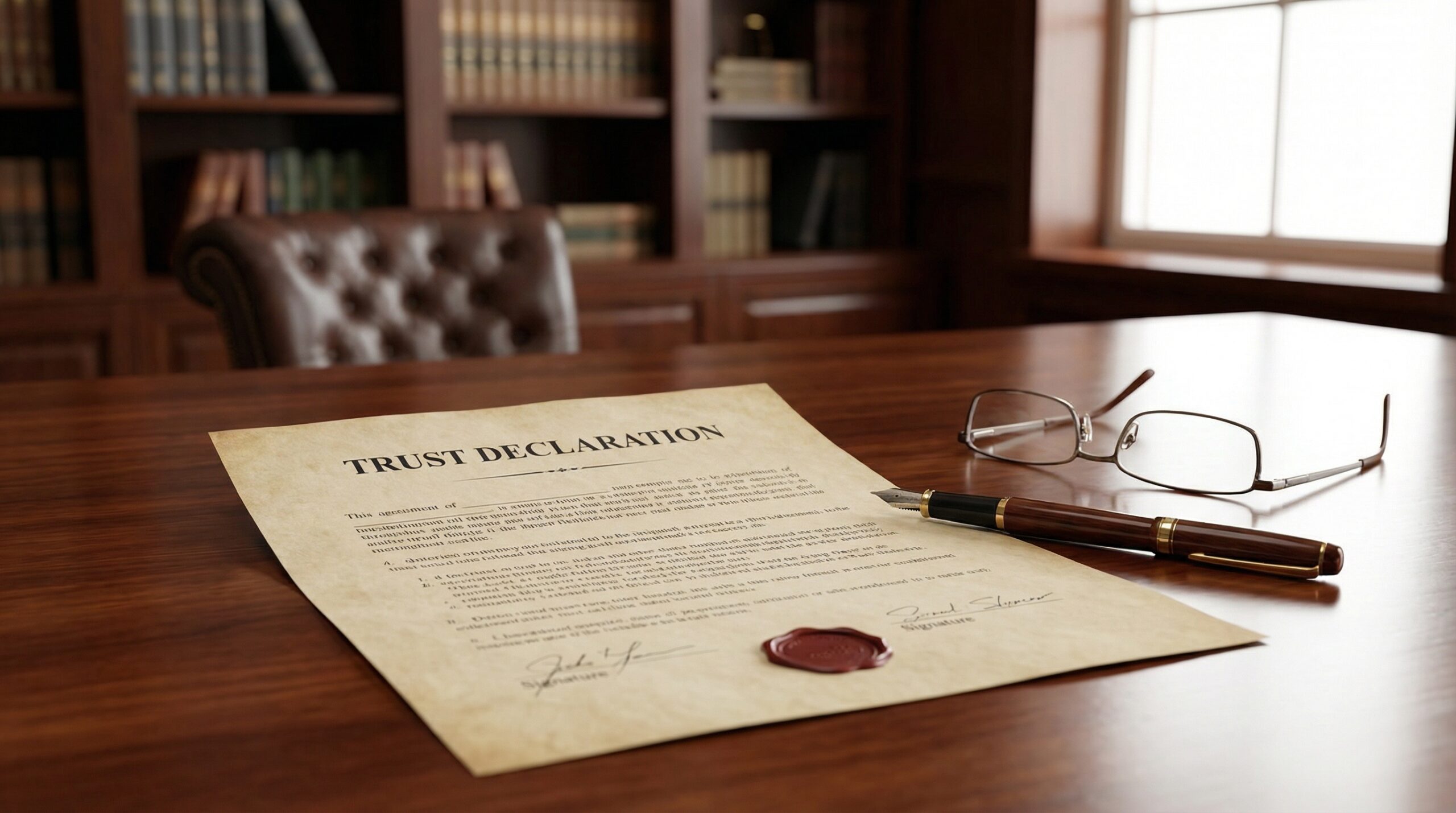

Trust Declaration vs Trust Deed: Key Differences and How to Choose
A trust is one of the most flexible and effective instruments for capital protection, estate planning and family wealth management. However, when establishing a trust, a fundamental question arises: which constitutive document should be used? A trust declaration and a trust deed are the two primary legal instruments through which trust relationships are created. Despite sharing a common purpose, they differ substantially in structure, legal consequences and scope of application. In this article, we examine each in detail, provide a comparative analysis, address tax implications and offer practical guidance on making the right choice.
What Is a Trust and What Conditions Are Required for Its Validity
A trust is a legal relationship in which one person (the settlor, or grantor) transfers assets to another person (the trustee) with an obligation to manage those assets for the benefit of third parties (the beneficiaries). This is a classic common law construct, now applied across dozens of jurisdictions worldwide.
The key participants in a trust structure are the settlor, who creates the trust and contributes assets; the trustee, who assumes legal ownership and bears fiduciary responsibility, the beneficiary, for whose benefit management is carried out; and the protector, who may be appointed to oversee the trustee’s actions.
For a trust to come into existence as a valid legal relationship, common law jurisdictions require the satisfaction of the three certainties:
- Certainty of intention – it must be clear from the document that the settlor intends to create a trust relationship, rather than a gift, agency or other transaction.
- Certainty of subject matter – the assets being transferred into trust must be clearly identified.
- Certainty of objects – the class of persons for whose benefit the trust is created must be defined or ascertainable.
The absence of any of the three certainties renders the trust void — regardless of whether it is constituted by a declaration or a deed. These requirements apply equally to trust declarations and trust deeds.
The process of trust creation and legal structuring begins with the selection of the legal form of the constitutive document – and this choice is far from a mere formality. It determines the very architecture of the relationship: who serves as trustee, how assets are transferred, the degree of legal protection afforded and the control mechanisms available to beneficiaries.
Trust Declaration (Declaration of Trust) — Definition and Mechanism
A trust declaration is a unilateral legal act by which the owner of assets declares that they hold certain property not for their own benefit, but as trustee for the benefit of designated beneficiaries.
Legal Nature of the Declaration
The defining feature of a trust declaration is that the settlor and the trustee are the same person. Assets are not transferred to a third party: the owner retains legal title but assumes fiduciary obligations to manage those assets for the benefit of the beneficiaries. The declaration is executed as a unilateral statement and does not require the signature of a second party. Nevertheless, it creates binding legal obligations from the moment of execution and imposes upon the settlor – trustee the full scope of fiduciary duties: duty of care, the obligation to act in the interests of the beneficiaries, the prohibition on conflicts of interest and the duty to maintain proper records.
It is important to note that while a declaration entails the combination of the settlor and trustee roles at inception, this does not preclude the subsequent appointment of a professional trustee. The declaration may contain provisions for the appointment of a successor trustee, and the settlor – trustee may subsequently transfer management of the assets to a separate person or entity by way of a separate instrument. In certain jurisdictions, the court also has the power to appoint a new trustee.
Formal Requirements for a Declaration
Despite its unilateral nature, a trust declaration may be subject to additional formal requirements depending on the jurisdiction and the type of assets involved. In England, where the subject matter of the declaration is land or an interest in land, the declaration must be in writing in accordance with Section 53 (1) (b) of the Law of Property Act 1925. An oral declaration in respect of real property does not create a valid trust. Registration with HM Land Registry may also be required. In civil law jurisdictions, the formal requirements may be even more stringent.
When a Trust Declaration Is Used
A trust declaration is most commonly employed in the following situations: recording beneficial ownership of real property (for example, where co-purchasers hold unequal shares that differ from the registered title) declaring trust ownership of shares in companies or securities; circumstances where the owner wishes to establish formally that an asset is held not for themselves but for specific individuals and simple family arrangements involving a limited number of assets and beneficiaries.
Practical Example
A father acquires an investment flat in London. Legal title is registered in his name; however, he executes a trust declaration in writing (as required by Section 53 (1) (b) LPA 1925), stating that he holds the property as trustee for his two children in equal shares. Legal title remains with the father, but beneficial ownership belongs to the children. The declaration records this relationship and sets out the basic terms of management.
Trust Deed — Definition and Mechanism
A trust deed is a bilateral (or multilateral) agreement between the settlor and the trustee, pursuant to which the settlor transfers legal ownership of assets to a separate person or entity for management in the interests of the beneficiaries.
Legal Nature of the Deed
Unlike a declaration, a trust deed presupposes that the settlor and the trustee are different persons. The document is executed by both parties and typically contains detailed provisions governing: the powers of the trustee, conditions for distributions, reporting requirements, the mechanism for the removal and replacement of the trustee, the role of the protector and dispute resolution procedures. The legal foundation for such deeds in leading trust jurisdictions is provided by dedicated legislative instruments, such as the Trusts (Jersey) Law 1984, which comprehensively regulates the rights, duties and liabilities of the parties to a trust relationship.
Revocable and Irrevocable Trusts
A critical aspect determined by the trust deed is whether the trust is revocable or irrevocable.
In the case of an irrevocable trust, the settlor relinquishes legal ownership of the assets and cannot unilaterally reclaim them or terminate the trust. This affords the highest degree of asset protection and fiscal autonomy for the trust.
In the case of a revocable trust, the settlor retains the right to terminate the trust and recover the assets. Such trusts offer greater flexibility but generally do not provide protection against creditors and in many jurisdictions are treated as fiscally transparent.
Furthermore, in offshore jurisdictions there is a widespread practice of reserved powers, whereby the settlor retains certain rights – for instance, the right to approve investment decisions or to amend the class of beneficiaries. Article 9A of the Trusts (Jersey) Law 1984 expressly provides that the reservation of powers by the settlor does not affect the validity of the trust. However, the existence and scope of reserved powers have a direct bearing on the tax characterisation of the trust and the degree of asset protection.
When a Trust Deed Is Used
A trust deed is the standard instrument for establishing complex trust structures: discretionary family trusts with multiple generations of beneficiaries; trusts for succession planning and asset transfer, asset protection trusts; charitable trusts; trusts with the appointment of a professional licensed trustee; and international trust structures holding assets across multiple jurisdictions.
Practical Example
A family with assets in Europe and Asia establishes a discretionary irrevocable trust in Jersey. The settlor enters into a trust deed with a licensed trust company, transferring legal title to a securities portfolio and shares in holding companies. The settlor reserves the right to approve investments above a specified threshold (reserved power). The deed defines the class of beneficiaries, the trustee’s powers, conditions for distributions, the protector’s role and the schedule for regular reporting.
Comparative Analysis — Declaration vs Deed
To make an informed decision, it is essential to understand clearly how a trust declaration and a trust deed differ across key parameters.
| CRITERION | TRUST DECLARATION | TRUST DEED |
|---|---|---|
| Type of document | Unilateral instrument | Bilateral agreement |
| Settlor and trustee | Same person | Different persons |
| Transfer of assets | No — assets remain with the settlor | Yes — assets are transferred to the trustee |
| Number of signatories | One | Two or more |
| Level of regulatory detail | Generally limited | Comprehensive — full suite of provisions |
| Structural complexity | Simple | Moderate to high |
| Cost of preparation | Lower | Higher |
| Level of legal protection | Basic | Enhanced |
| Professional trustee | Not at inception, but possible subsequently | Yes — standard practice |
| Typical application | Recording beneficial ownership | Family, succession and asset protection trusts |
| Continuity of management | Limited — depends on provisions of the declaration | Ensured by trustee succession mechanism |
| Resilience to challenge | Lower | Higher |
The key distinction is one of substance rather than form. A trust declaration records the existing state of affairs – the owner declares that an asset is held for the benefit of others. A trust deed creates a new legal reality – assets change legal owner and management passes to an independent trustee.
A further critical aspect is continuity. In the case of a declaration, if the settlor (who is also the trustee) loses capacity or dies, a management vacuum arises – unless the declaration contains provisions for the appointment of a successor. In the case of a deed with a professional trustee, management is uninterrupted – the trust company ensures continuity regardless of circumstances.
How to Choose Between a Declaration and a Deed
The choice between a trust declaration and a trust deed is determined by the settlor’s objectives, the nature of the assets, the jurisdictional context and international considerations.
The Objectives of the Trust as the Determining Factor
Where the primary objective is to record beneficial ownership of a specific asset without transferring legal title to a third party, a trust declaration may be a sufficient instrument. This is relevant, for example, in the case of a joint property purchase or where there is a need to formally separate legal and beneficial ownership.
Where, however, the objective is comprehensive succession planning, asset protection and tax structuring, multigenerational family wealth management or the appointment of an independent professional trustee, the only adequate instrument is a trust deed.
Jurisdictional Considerations and the Hague Convention
The practice of using these instruments varies considerably across jurisdictions. In England and Wales, a Declaration of Trust is widely used in real property transactions. In offshore trust jurisdictions, the Trust Deed is the standard for complex structures. In Jersey, the activities of trust companies are regulated by the Jersey Financial Services Commission, which ensures a high standard of supervision.
For families with international assets, the Hague Convention on the Law Applicable to Trusts and on their Recognition (1985) is of particular significance. The Convention establishes uniform rules for the recognition of trusts in contracting states, including the United Kingdom, Italy, Switzerland, Liechtenstein, Australia and a number of other jurisdictions. This means that a trust established in one jurisdiction (for example, Jersey) may be recognised and have legal effect in a civil law country – provided the requirements of the Convention are met. The choice of constitutive document may influence the ease with which a trust is recognised in another state.
Requirements as to the form of the document are determined not only by the jurisdiction of the trust’s registration but also by the jurisdiction in which each asset is situated. For real property, virtually all countries impose additional formalities – notarial certification, registration or execution as a deed.
The Role of Professional Advisers
The decision regarding the form of the constitutive document should not be taken without the involvement of qualified lawyers specialising in trust law.
Practical example:
An entrepreneur from continental Europe owns investment real estate in London and a securities portfolio held through a broker in Singapore. For the London property, he executes a trust declaration in writing, recording beneficial ownership in favour of his children. For the management of the securities portfolio and long-term succession planning, a separate discretionary trust is established in Jersey by way of a trust deed with the appointment of a professional trustee. Recognition of the Jersey trust in the entrepreneur’s country of residence is facilitated by the provisions of the Hague Convention.
Tax Implications of the Choice of Constitutive Document
The form of the constitutive document – trust declaration or trust deed – may have a material impact on the tax characterisation of the trust. This is one of the most important, yet frequently underestimated, aspects of the choice.
The “look-through” principle where the settlor retains control. Where the settlor retains significant control over the trust assets, the tax authorities of a number of countries may “look through” the trust structure and tax the trust’s income directly at the level of the settlor. This is particularly relevant for trust declarations, where the settlor simultaneously serves as trustee, as well as for revocable trusts and trusts with broad reserved powers.
United Kingdom. UK tax law contains the settlor – interested trusts rules (ITTOIA 2005, Part 5, Chapter 5), under which the trust’s income is taxed at the level of the settlor where the settlor or their spouse is a beneficiary or retains certain rights.
United States. US tax legislation provides for grantor trust rules (Internal Revenue Code, Sections 671–679), under which the trust is treated as fiscally transparent for federal tax purposes where the settlor retains certain powers.
EU member states and automatic exchange of information. Under the Common Reporting Standard (CRS), trust structures are subject to automatic exchange of information. The classification of a trust as an “active” or “passive” non-financial entity, as well as the identification of “controlling persons”, depends, inter alia, on the degree of control exercised by the settlor and the form of the constitutive document.
Accordingly, the choice between a declaration and a deed, and between a revocable and an irrevocable trust, is not merely a legal decision but also a fiscal one, which should be made with the involvement of a tax adviser.
Common Mistakes and Legal Risks
An incorrect choice between a trust declaration and a trust deed is an error whose consequences may only materialise years later.
Using a declaration instead of a deed for complex structures. Where a settlor creates a trust declaration to manage substantial assets with multiple beneficiaries, the document may lack the necessary mechanisms for control, reporting and dispute resolution. In the event of a conflict between beneficiaries, the absence of detailed regulation leads to protracted and costly litigation.
Failure to comply with formal requirements. An oral declaration in respect of real property in England does not create a valid trust (Section 53 (1) (b) LPA 1925). Disregard for formal requirements may result in the invalidity of the entire structure.
Absence of continuity. A trust declaration without provisions for the appointment of a successor trustee creates a legal vacuum in the event of the death or incapacity of the settlor – trustee. Without a pre-established mechanism and proper trust structure management, the situation may require judicial intervention.
Tax consequences. As discussed above, an incorrect choice of document form or trust type may result in an adverse tax characterisation – the trust being treated as transparent, with taxation at the level of the settlor.
Risk of challenge. A trust declaration, where the settlor retains legal ownership of the assets, is more vulnerable to challenge by creditors than a trust deed under which assets have been effectively transferred to an independent trustee.
Typical scenario. A business owner executed a trust declaration in respect of shares in several companies. The declaration was prepared without the involvement of a trust law specialist. Following his death, it emerged that the declaration contained no provisions for the governance of the trust in the event of the trustee’s death, did not provide for the appointment of a successor, did not regulate the terms of distributions and did not comply with the formal requirements of one of the jurisdictions in which assets were situated. The beneficiaries were compelled to apply to the court – the proceedings lasted over a year and were accompanied by a family dispute.
Frequently Asked Questions (FAQ)
Can a trust declaration be converted into a trust deed?
There is generally no mechanism for directly “converting” one document into the other. However, it is possible to create a new trust by way of a trust deed, with a subsequent transfer of assets from under the declaration into the new trust. This process requires legal advice and may have tax consequences depending on the jurisdiction and the type of assets involved.
Which document provides better asset protection?
A trust deed generally affords a higher level of protection — particularly where the trust is irrevocable and assets have been effectively transferred to an independent trustee. This makes it significantly more difficult for the settlor’s creditors to challenge the arrangement.
Is a notary required for the execution of a trust declaration or deed?
In most common law jurisdictions, notarisation is not required. However, for real property, virtually all countries impose additional formalities: written form (Section 53 (1) (b) LPA 1925 in England), land registry registration, and in civil law jurisdictions — notarial certification. The requirements are determined by the law of the country in which the asset is situated.
In which jurisdictions is the declaration more commonly used, and in which is the deed preferred?
The trust declaration is widely used in England and Wales, particularly in real property transactions. The trust deed is the standard in offshore jurisdictions – Jersey, Guernsey, the Cayman Islands and Singapore. In Liechtenstein, trust relationships are governed by the dedicated provisions of the Personen – und Gesellschaftsrecht (PGR).
Can a trust declaration be used for succession planning?
In theory, yes – but in practice it is suitable only for straightforward situations. For comprehensive succession planning involving multiple generations of beneficiaries, a trust deed is a significantly more robust and functional instrument.
Which document should be chosen when appointing a professional trustee?
When appointing a professional licensed trustee, the standard instrument is a trust deed. A declaration presupposes the combination of the settlor and trustee roles at inception, although a subsequent transfer of management to a professional trustee is possible by way of a separate legal instrument.
What are the three certainties and why do they matter?
The three certainties are the mandatory conditions for the validity of a trust under common law: certainty of intention, certainty of subject matter and certainty of objects. Failure to satisfy any of these conditions renders the trust void, irrespective of the form of the constitutive document.
Conclusion — Making an Informed Choice of Legal Form
A trust declaration and a trust deed are not interchangeable documents but two fundamentally different instruments with distinct legal, tax and practical consequences. A declaration is suitable for recording beneficial ownership in straightforward situations. A deed is the instrument of choice for establishing fully-fledged trust structures with independent management, detailed regulation and long-term continuity.
For high-net-worth families considering a trust as an instrument of succession planning and business transfer, a trust deed with the appointment of a professional licensed trustee is the recommended standard. It provides legal certainty, resilience to challenge, robust control mechanisms and continuity of management for generations to come.
When selecting the form of the constitutive document, it is essential to take into account not only the legal but also the tax characterisation of the trust, the formal requirements of every jurisdiction in which assets are located, and the provisions of the Hague Convention on the recognition of trusts. Do not make this decision without consulting a lawyer and a tax adviser specialising in trust law. The right choice at the stage of trust creation prevents costly problems in the future.