
Trusts in Singapore: Formation, Taxes, and Trust Structure
Trust in Singapore are widely considered one of the most effective legal instruments for international wealth management, asset protection, and long-term financial planning. Over the past few decades, Singapore has evolved into a leading global financial hub combining a stable legal system, transparent regulation, and a sophisticated banking infrastructure. These characteristics make Singapore an attractive jurisdiction for entrepreneurs, investors, and high-net-worth families seeking to structure capital, manage investments, and plan intergenerational wealth transfer.
In modern international financial practice, trusts are used for various purposes, including portfolio management, asset protection, estate planning, and philanthropic initiatives. The Singaporean legal system offers a flexible framework rooted in English common law principles, which makes it familiar and predictable for international investors and legal professionals.
In practice, a properly structured trust separates legal ownership of assets from their economic benefit. For example, a business owner may transfer shares of an international holding company into a trust. The trustee holds legal ownership of the shares, while family members or designated beneficiaries receive income distributions. This structure helps protect assets while ensuring continuity of control and strategic management.
Trusts in Singapore as a Legal Jurisdiction
Singapore recognizes trusts based on domestic legislation rather than international conventions. This means that the legal regime governing trusts is fully defined by national statutes and case law. The main legislative framework includes the Trust Companies Act 2005 and legal principles derived from English common law.
Singapore has long been recognized as one of the world’s most important financial centers. According to the World Bank and various global competitiveness reports, the country consistently ranks among the most business-friendly jurisdictions. Its strong financial regulatory environment and well-developed infrastructure make Trusts in Singapore particularly attractive for international investors and multinational families.
Trust structures in this jurisdiction are commonly used for:
-
international tax planning
-
asset protection strategies
-
estate and succession planning
-
family wealth management
-
structuring international investment portfolios
One of the distinctive features of Singapore’s trust framework is that there is no mandatory public registration for most trusts. The legal relationship becomes effective once assets are transferred to the trustee with the intention of creating a trust. This approach ensures a high level of privacy while still complying with regulatory standards.
A practical example can be observed in family-owned international businesses. A business owner may place shares of a holding company into a trust. The trustee manages these shares under the trust deed, while beneficiaries – often family members – receive dividends or other financial benefits. Such a structure ensures the preservation of family wealth across generations while maintaining centralized governance.
Legal Framework and Regulation of Trusts in Singapore
Singapore’s legal system is largely derived from the English common law tradition, making it highly familiar to international legal practitioners and financial advisors. Trust law is governed by national statutes, court precedents, and regulatory oversight from financial authorities.
The primary regulatory body responsible for supervising trust companies is the Monetary Authority of Singapore (MAS). MAS oversees licensing, compliance, and financial supervision of trust service providers operating within the jurisdiction.
The main legal sources regulating trusts include:
-
Trust Companies Act (2005)
-
MAS regulatory guidelines
-
English common law principles
Professional trustees must obtain licenses and comply with strict compliance requirements. These include international standards for Anti-Money Laundering (AML) and Know-Your-Customer (KYC) procedures. Such regulations align Singapore with global financial transparency standards promoted by organizations such as the Financial Action Task Force (FATF).
Key regulatory features include:
-
mandatory licensing for professional trust companies
-
strict compliance and financial reporting requirements
-
strong confidentiality protections for beneficiaries
-
absence of a public trust registry
This regulatory model balances transparency with privacy. While regulators maintain oversight of financial institutions, detailed information about trust beneficiaries is generally not publicly disclosed.
A practical example illustrates how this framework operates. An international investor may create a trust that owns an investment portfolio across multiple jurisdictions. The trustee is responsible for executing the investment strategy and managing the assets, while beneficiaries receive distributions based on the conditions outlined in the trust deed.
Requirements for Establishing Trusts in Singapore
Creating a trust requires compliance with several fundamental legal principles commonly known in trust law as the “three certainties”: certainty of intention, certainty of subject matter, and certainty of beneficiaries.
The first requirement is a clear intention by the settlor to establish a trust. The settlor must explicitly express the desire to transfer assets to a trustee to be managed for the benefit of designated beneficiaries.
Intention of the Settlor
The settlor must clearly define the purpose of the trust. Typical objectives include asset protection, wealth management, tax structuring, and estate planning. These intentions are documented in the trust deed and related legal documentation.
Certainty of Assets
Assets transferred into the trust must be clearly identified and defined. These may include:
-
cash deposits
-
company shares
-
investment portfolios
-
real estate
-
intellectual property rights
For instance, a technology entrepreneur may transfer shares of a startup or a diversified investment portfolio consisting of international funds into the trust.
Certainty of Beneficiaries
Beneficiaries must either be specifically named or defined as a class of persons. For example, beneficiaries may be “the settlor’s children” or “members of the family.”
The Trust Deed
The primary legal document governing the trust is the Trust Deed. This document outlines:
-
the purpose of the trust
-
the rules governing asset management
-
rights and duties of each party
-
the distribution of income and capital
For trusts involving real estate or estate planning arrangements, written documentation is typically mandatory under Singapore law.
Further reading on trust structures can be found in the article on Trust law.
Taxation of Trusts in Singapore
One of the most attractive features of Singapore as a trust jurisdiction is its competitive tax environment. The country operates under a territorial taxation system, meaning that only income sourced within Singapore is generally subject to taxation.
Because of this system, Trusts in Singapore are often used as part of international tax planning strategies and cross-border investment structures. Importantly, Singapore does not impose certain taxes common in other jurisdictions.
Key tax advantages include:
-
no capital gains tax
-
no inheritance tax
-
no gift tax
Singapore’s tax framework is administered by the Inland Revenue Authority of Singapore (IRAS), which provides guidelines on the taxation of trusts and trust distributions.
There are two commonly used trust structures in Singapore.
Qualifying Foreign Trust (QFT)
This structure is primarily designed for foreign settlors and international investors.
Key benefits include:
-
exemption from tax on certain foreign-sourced income
-
high levels of confidentiality
-
flexibility in international tax planning
Locally Administered Trust (LAT)
This type of trust is typically used when the trustee or beneficiaries are Singapore residents.
Characteristics include:
-
taxation limited to Singapore-sourced income
-
the ability to benefit from Singapore’s network of double taxation treaties
More information about Singapore’s tax framework can be found through the Ministry of Finance Singapore.
Participants in Trusts in Singapore
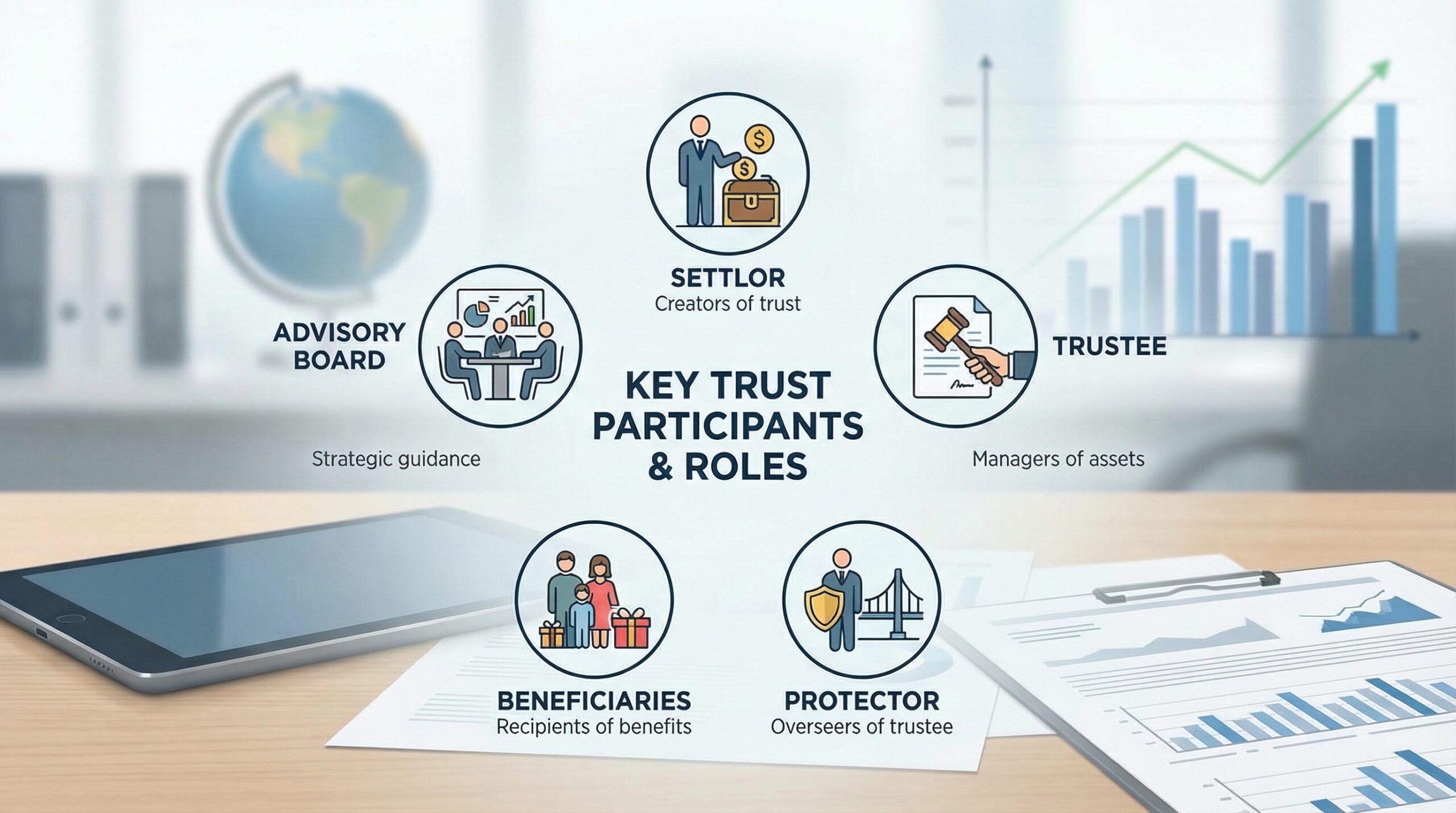
Every trust structure involves several key participants, each with a defined legal role.
Settlor
The settlor is the individual or entity that establishes the trust and transfers assets into it.
The settlor may be:
-
an individual
-
a corporation
In certain cases, the settlor may also be a beneficiary, depending on the structure of the trust.
Trustee
The trustee is responsible for managing the trust assets and holding legal title to them.
Key responsibilities include:
-
legal ownership of assets
-
management and investment of property
-
compliance with the terms of the trust deed
Trustees may be:
-
licensed trust companies
-
private trust companies (PTCs)
Protector
A protector is an optional but common participant in modern trust structures.
Their role is to supervise the trustee and protect the interests of beneficiaries. The protector may have authority to:
-
veto certain decisions
-
approve major transactions
-
oversee trustee performance
Beneficiaries
Beneficiaries are the individuals or entities that receive financial benefits from the trust.
They may include:
-
individuals
-
corporations
-
charitable organizations
Taxation generally occurs in the beneficiaries’ country of residence.
In international practice, trusts are often used alongside corporate structures. For example, shares of a company may be held by a trust while the company itself operates globally. More information about corporate structuring can be found in the article on company registration in Singapore.
Example of a Trust Structure in Singapore
Below is an example of a typical trust structure.
| Role | Possible Participants | Function |
|---|---|---|
| Settlor | individual or company | transfers assets |
| Trustee | licensed trust company | manages assets |
| Protector | individual or organization | supervises trustee |
| Beneficiaries | individuals or companies | receive income |
Trust Deed Content
A trust deed typically includes:
-
the name of the trust
-
details of the parties involved
-
description of assets
-
objectives of the trust
-
rules for asset management
-
distribution mechanisms
-
duration of the trust
A practical example would involve a family trust holding shares of an investment holding company. The trustee manages the portfolio while beneficiaries receive income distributions according to predefined rules.
How to Establish a Trust in Singapore: Step-by-Step Checklist
Establishing a trust typically involves several stages.
-
Determining the purpose and type of trust (QFT or LAT)
-
Selecting the participants involved in the structure
-
Appointing a licensed trustee
-
Preparing the trust deed and supporting documents
-
Transferring assets to the trust
-
Completing AML and KYC compliance procedures
-
Confirming the tax status of the trust
-
Commencing asset management and administration
In practice, the process may take several weeks or months depending on the complexity of the structure and the nature of the assets being transferred.
FAQ: Trusts in Singapore
Can foreigners establish a trust in Singapore?
Yes. Many trusts in Singapore are created by foreign investors, particularly under the Qualifying Foreign Trust regime.
Is trust registration required?
Generally, registration is not required. A trust becomes effective once assets are transferred to the trustee and the trust deed is executed.
How confidential are trusts in Singapore?
Singapore offers a high level of confidentiality because there is no public registry of trusts.
Can the settlor also be a beneficiary?
Yes, in some structures the settlor may also be a beneficiary, although certain conditions may apply.
What assets can be placed into a trust?
Almost any type of asset can be transferred into a trust, including:
-
cash
-
company shares
-
investment portfolios
-
real estate
-
business ownership interests
This flexibility makes Trusts in Singapore one of the most popular instruments for international wealth management and asset protection.